Small-scale miners welcome gemstone cutting, polishing training

NAMPA
2026-03-26
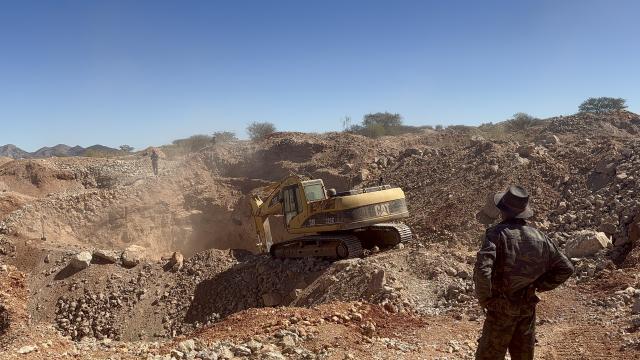
NEU-SCHWABEN, 22 March 2026 - Chairperson of the Small-scale miners at New-Schwaben Metirapi Lucky Kapekarua looks on as an excavator digs in a mining pit for extraction of tourmaline. (Photo by: Isabel Bento) NAMPA NEU-SCHWABEN, 22 March 2026 - Chairperson of the Small-scale miners at New-Schwaben Metirapi Lucky Kapekarua looks on as an excavator digs in a mining pit for extraction of tourmaline. (Photo by: Isabel Bento) NAMPA
By Isabel Bento
NEU-SCHWABEN, 26 MAR (NAMPA) – A group of small-scale miners from the Neu-Schwaben area is set to undergo specialised training in gemstone cutting and polishing at the Karibib Gemstone Polishing Centre.
Nine miners from the area are among 28 trainees selected nationwide to attend a six-month gemstone cutting, polishing and jewellery-making course at the Karibib Gemstone Polishing Centre.
Of the total intake, 15 participants are drawn from the Erongo and Kunene regions, with the remainder representing other parts of the country.
The training, targeting unemployed youth and women aged between 18 and 35 with at least a Grade 8 qualification, forms part of government efforts to empower communities and stimulate local enterprise development.
According to the Ministry of Industries, Mines and Energy (MIME), the initiative aligns with Namibia’s broader industrialisation agenda.
“Small-scale mining stands as a vital sub-sector within Namibia’s broader mining industry, supporting livelihoods for a significant number of individuals and their families, thereby playing a crucial role in poverty reduction and enhancing living standards,” the ministry said.
It added that the programme supports the country’s ambitions, as outlined in national development frameworks, to grow local production and ensure more equitable wealth distribution through value addition.
Metirapi Lucky Kapekarua, the chairperson of the small-scale miners at Neu-Schwaben where predominantly tourmaline is mined, said the training is particularly important in addressing one of the biggest challenges faced by small-scale miners, which is low returns from selling unprocessed stones.
“When you sell a stone in its rough form, you get far less value. But once it is cut and polished, the same stone can fetch a much higher price,” he said.
Kapekarua also highlighted ongoing difficulties in accessing formal markets, noting that miners often struggle to find reliable buyers and fair pricing for their gemstones.
For trainee Martha Hangula, who has spent three years in small-scale mining, the opportunity represents a chance to break the cycle of uncertainty.
“If you do not find stones, you go hungry. I am therefore very excited about gaining skills that could improve my income, in turn an improved livelihood for my family,” she stated.
Similarly, Paavo Kapanda, who relocated from the Omusati Region over a year ago in search of better opportunities, said the course will help him understand how to properly value his gemstones.
“I want to learn cutting, polishing and jewellery making so I can know how much to charge for my work,” he said.
Speaking at a recent graduation ceremony of a previous cohort, MIME Deputy Director for Regional Economic Development, Pinehas Shinyala, said the Karibib centre remains central to government’s beneficiation drive.
He noted that more than 90 per cent of gemstones produced by small-scale miners are still exported in raw form, resulting in lost income and employment opportunities.
Shinyala emphasised that the centre was established to equip especially youth and women with practical skills, discipline and entrepreneurial capacity.
Graduates are increasingly being absorbed into the diamond cutting and polishing industry, with about 83 per cent of trainees from recent cohorts securing employment.
Since its establishment, the Karibib Gemstone Polishing Centre has trained nearly 250 Namibians, contributing to skills development and job creation within the mining value chain.
(NAMPA)
IB/AS

Latest NAMPA photos

steenkamp

steenkamp

NAMPA
OKAHANDJA, 18 July 2015 - Chief Tjinaani Maharero of the Maharero Traditional Authority and head of the Otjika-Tjamuaha Royal House. (Photo: Contributed) NAMPA.

OKAHANDJA, 18 July 2015 - Chief Tjinaani Maharero of the Maharero Traditional Authority and head of the Otjika-Tjamuaha Royal House. (Photo: Contributed) NAMPA.

NAMPA
WINDHOEK, 18 August 2026 - First Gentleman Lieutenant General Epaphras Denga Ndaitwah on Tuesday launched the DEN Impact Foundation, an initiative aimed at implementing targeted programs to tackle the escalating social, educational, and mental health issues affecting boys. (Pho: Contributed) NAMPA.

WINDHOEK, 18 August 2026 - First Gentleman Lieutenant General Epaphras Denga Ndaitwah on Tuesday launched the DEN Impact Foundation, an initiative aimed at implementing targeted programs to tackle the escalating social, educational, and mental health issues affecting boys. (Pho: Contributed) NAMPA.

NAMPA
WINDHOEK, 18 August 2026 - Prime Minister Elijah Ngurare speaking at the launch of DEN Impact Foundation on Tuesday in Windhoek. (Photo: Contributed) NAMPA.

WINDHOEK, 18 August 2026 - Prime Minister Elijah Ngurare speaking at the launch of DEN Impact Foundation on Tuesday in Windhoek. (Photo: Contributed) NAMPA.

NAMPA
/KHOICHAS, 14 August 2026 - Namibia’s independence was a collective victory. The southern regions of Hardap and ||Karas were central to the struggle, anchored by local churches that risked everything to shelter PLAN fighters and educate the future leaders of our nation. (Photo by: Uakutura Kambaekua) NAMPA.

/KHOICHAS, 14 August 2026 - Namibia’s independence was a collective victory. The southern regions of Hardap and ||Karas were central to the struggle, anchored by local churches that risked everything to shelter PLAN fighters and educate the future leaders of our nation. (Photo by: Uakutura Kambaekua) NAMPA.

NAMPA
HOACHANAS, 12 August 2026 - Historian and liberation struggle icon Markus Kooper, in collaboration with the Hoachanas community, has established a community library to preserve the history of the southern region, including the Red Clan history and past freedom struggle events. (Photo by: Uakutura Kambaekua) NAMPA.

HOACHANAS, 12 August 2026 - Historian and liberation struggle icon Markus Kooper, in collaboration with the Hoachanas community, has established a community library to preserve the history of the southern region, including the Red Clan history and past freedom struggle events. (Photo by: Uakutura Kambaekua) NAMPA.

NAMPA
GIBEON, 13 August 2026 - The African Methodist Episcopal Private Community School (AMEPS) in Gibeon was a significant community-operated institution founded by the AME Church and local leaders, including Hendrik Witbooi, during the fight for freedom. It ceased operations and was integrated into the state school system in 2007. (Photo by: Uakutura Kambaekua) NAMPA.

GIBEON, 13 August 2026 - The African Methodist Episcopal Private Community School (AMEPS) in Gibeon was a significant community-operated institution founded by the AME Church and local leaders, including Hendrik Witbooi, during the fight for freedom. It ceased operations and was integrated into the state school system in 2007. (Photo by: Uakutura Kambaekua) NAMPA.

NAMPA
/KHOICHAS, 14 August 2026 - Jacqueline Juliana Rukamba, a former principal at Khoichas Primary School in the Karas region, significantly contributed to Namibia's independence, particularly in education, during the 1970s and 1980s. (Photo by: Uakutura Kambaekua) NAMPA.

/KHOICHAS, 14 August 2026 - Jacqueline Juliana Rukamba, a former principal at Khoichas Primary School in the Karas region, significantly contributed to Namibia's independence, particularly in education, during the 1970s and 1980s. (Photo by: Uakutura Kambaekua) NAMPA.

NAMPA