Transnamib welcomes pilot hydrogen-powered locomotives

NAMPA
2026-03-27
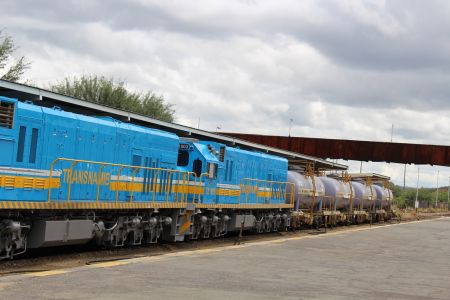
WINDHOEK, 01 March 2017- One of six newly acquired TransNamib locomotives and four of the 90 sulphuric acid tankers launched in the capital on Wednesday. (Photo by: Etuna Shikalepo) NAMPA WINDHOEK, 01 March 2017- One of six newly acquired TransNamib locomotives and four of the 90 sulphuric acid tankers launched in the capital on Wednesday. (Photo by: Etuna Shikalepo) NAMPA
SWAKOPMUND, 27 MAR (NAMPA) – TransNamib Holdings Limited has welcomed the rollout of a pilot programme to test a dual-fuel hydrogen-powered locomotive, describing it as a key step towards modernising its fleet and advancing low-carbon rail transport.

In a media response to Nampa, TransNamib’s Manager of Corporate Communications, Alina Garises, said the board has approved a six-month trial of the prototype locomotive, which will operate on both hydrogen and diesel along the Walvis Bay-Windhoek corridor.

The pilot, implemented in partnership with CMB.TECH Namibia and supported by Africa Global Logistics, will initially cover 50 return trips between the Port of Walvis Bay and a container depot near Windhoek.

Garises said the trial will be evaluated using a performance matrix focusing on fuel consumption, reliability, operational efficiency and the locomotive’s ability to meet customer requirements.

“Any decision on whether to expand the trial beyond the initial 50 round trips will only be made after the full six-month evaluation period,” she said.

She added that the long-term viability of hydrogen as an energy source will depend largely on its cost in Namibia, with affordability expected to be a key factor in determining any future rollout.

As part of the trial, TransNamib will conduct a comprehensive set of operational and technical assessments along the 414-kilometre Walvis Bay-Windhoek corridor, which is characterised by steep elevation changes.

Garises said the route provides a rigorous test environment for the pilot.

“These will include safety, training and operational procedures related to hydrogen storage, handling and refuelling, as well as fuel efficiency, locomotive performance, reliability, maintenance requirements and overall cost-efficiency compared to conventional diesel locomotives,” she said.

TransNamib also indicated that while its current fleet primarily relies on diesel locomotives, it may explore converting portions of the fleet to hydrogen-diesel technology depending on the outcome of the pilot.

During the trial phase, hydrogen storage, handling and refuelling will be managed by CMB.TECH Namibia, while TransNamib will focus on compliance, operational integration and building internal capacity in training and maintenance.

By repurposing an existing locomotive, the pilot is also expected to provide a practical and cost-effective framework for decarbonising rail transport across Namibia’s largely non-electrified network.
(NAMPA)
IB/HP

Latest NAMPA photos

WINDHOEK, 26 March 2026 - Vice president Lucia Witbooi (second from left) receives donated equipment bound for Mokganedi Tlhabanelo High School from Pupkewitz Megabuild's Financial Director, Danie Du Toit (right). (Photo by: Ali Negumbo) NAMPA

WINDHOEK, 26 March 2026 - Vice president Lucia Witbooi (second from left) receives donated equipment bound for Mokganedi Tlhabanelo High School from Pupkewitz Megabuild's Financial Director, Danie Du Toit (right). (Photo by: Ali Negumbo) NAMPA

NAMPA
KARIBIB, 20 March 2026 - Chief Executive Officer of the Karibib Town Council Tangeni Enkono. (Photo by: Isabel Bento) NAMPA

KARIBIB, 20 March 2026 - Chief Executive Officer of the Karibib Town Council Tangeni Enkono. (Photo by: Isabel Bento) NAMPA

NAMPA
KARIBIB, 20 March 2026 - Children fetching water at a prepaid water station in the Harambee informal settlement in Karibib. (Photo by: Isabel Bento) NAMPA

KARIBIB, 20 March 2026 - Children fetching water at a prepaid water station in the Harambee informal settlement in Karibib. (Photo by: Isabel Bento) NAMPA

NAMPA
KARIBIB, 20 March 2026 - A portion of the Haraambe Informal settlement in Karibib. (Photo by: Isabel Bento) NAMPA

KARIBIB, 20 March 2026 - A portion of the Haraambe Informal settlement in Karibib. (Photo by: Isabel Bento) NAMPA

NAMPA
NEU-SCHWABEN, 22 March 2026 - Raw tourmaline extracted in a mining pit at the Neu-Schwaben small-scale mining settlement. (Photo by: Isabel Bento) NAMPA

NEU-SCHWABEN, 22 March 2026 - Raw tourmaline extracted in a mining pit at the Neu-Schwaben small-scale mining settlement. (Photo by: Isabel Bento) NAMPA

NAMPA
NEU-SCHWABEN, 22 March 2026 - Chairperson of the Small-scale miners at New-Schwaben Metirapi Lucky Kapekarua looks on as an excavator digs in a mining pit for extraction of tourmaline. (Photo by: Isabel Bento) NAMPA

NEU-SCHWABEN, 22 March 2026 - Chairperson of the Small-scale miners at New-Schwaben Metirapi Lucky Kapekarua looks on as an excavator digs in a mining pit for extraction of tourmaline. (Photo by: Isabel Bento) NAMPA

NAMPA
WINDHOEK, 25 March 2026 - The Motor Vehicle Accident (MVA) Fund has intensified efforts to reduce road crashes by placing greater emphasis on the health and wellbeing of truck drivers through its Truckers’ Wellness Campaign. (Photo: Contributed)

WINDHOEK, 25 March 2026 - The Motor Vehicle Accident (MVA) Fund has intensified efforts to reduce road crashes by placing greater emphasis on the health and wellbeing of truck drivers through its Truckers’ Wellness Campaign. (Photo: Contributed)

NAMPA
NANKUNTWE, 10 March 2026 – The Nankuntwe Combined School and two other schools that were closed recently will relocate to higher ground, where they will operate from tents. Nankuntwe CS will operate from Luhonono. (Photo: Contributed)

NANKUNTWE, 10 March 2026 – The Nankuntwe Combined School and two other schools that were closed recently will relocate to higher ground, where they will operate from tents. Nankuntwe CS will operate from Luhonono. (Photo: Contributed)

NAMPA