FROM THE STREETS TO SECOND CHANCES
FROM THE STREETS TO SECOND CHANCES
By Isabel Bento
(NAMPA FEATURES SERVICE)
HENTIES BAY, 25 MAR (NAMPA) – For 17-year-old Obama Evangelista, the simple act of blowing out candles on a birthday cake was once unimaginable, a small, ordinary moment that had always felt out of reach in a life shaped by survival.
Standing among dozens of other young people at the National Youth Service (NYS) Training Centre at Henties Bay, he recalled how, not long ago, his days were spent searching for food, shelter and safety on the streets, where fear and rejection were constant companions.
But time spent at the centre for a five-week rehabilitation programme has shown Evangelista a different side of life.
“We attended church services, celebrated birthdays with cake, had movie nights and learned how to control our anger and emotions. Some of us experienced these things for the first time in our lives,” he said softly, his voice carrying both disbelief and gratitude.
On 13 March 2026, Evangelista and 75 other children completed the pilot programme designed to help them re-discover not only structure and discipline, but also their sense of worth.
The programme, implemented by the NYS in partnership with the Ministry of Gender Equality and Child Welfare (MGECW), forms part of a broader governmental effort to respond to children living and working on the streets, classified under Namibia’s Child Care and Protection Act as children in need of protective services.
Behind each child is a story often too heavy for their age.
Some were abandoned as infants, others raised in homes broken by substance abuse, poverty and violence. Many had never set foot in a classroom and some had learned to survive through begging. Others were drawn into crime, drugs and dangerous peer networks in search of belonging.
One case shared by social workers was of an 11-year-old girl who grew up at a dumpsite. She was exposed to drugs from the age of eight and never attended school. Another recounted a 14-year-old boy who became entangled in gang activity, resorting to theft while fleeing abuse.
“These are not just statistics. These are children who were forced to grow up too soon,” a social worker involved in the programme said.
Launched on 06 February 2026, the pilot programme brought together children aged 12 to 18 from the Hardap, Khomas, Erongo, Otjozondjupa and Omaheke regions.
Over five weeks in Henties Bay, they underwent a carefully structured rehabilitation process combining discipline-based training with psychosocial support.
Days began with drill formations and physical exercise, instilling routine and teamwork. Lessons followed, not only in basic agricultural skills and civic responsibility, but in something many had never been taught - how to understand themselves.
Through counselling sessions, the children confronted grief, loss and trauma. They learned anger management, problem-solving and how to navigate substance dependency, and for many, it was the first time anyone had asked how they felt.
Medical care formed a critical part of the journey as many arrived malnourished, battling withdrawal symptoms or untreated wounds. At the training centre, they received daily meals, healthcare and, in some cases, specialised treatment, including dental care and psychological support.
Slowly, change began to take root.
“They started to trust again, you could see it in how they spoke, how they carried themselves. They began to believe they mattered,” one programme facilitator said.
Evangelista echoed this transformation.
“We were victims of drugs and alcohol, physical, mental and sometimes sexual abuse. Some of us were forced into criminal activities or begged for food because there was nothing at home.
“But giving up is not an option. We must move forward and make our lives better,” he stated passionately.
The programme also reintroduced the children to something they had long been denied; childhood itself.
Laughter returned during movie nights, bonds were formed over shared meals and for a moment, the weight of survival lifted.
At their recent graduation ceremony, Minister of Education, Innovation, Youth, Sport, Arts and Culture, Sanet Steenkamp, praised their resilience.
“Your participation in this programme tells a story of courage. Many of you have faced circumstances that no child should ever have to endure, yet you chose to show up, to learn and to grow,” she said.
She noted that the initiative is part of government’s broader commitment to restoring dignity and reintegrating vulnerable children into society through education and support systems.
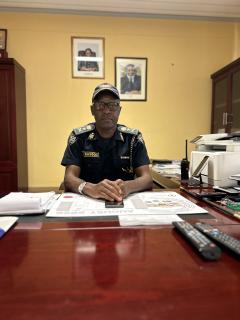
NYS Commissioner Felix Musukubili highlighted the role of discipline in reshaping lives, pointing to the confidence and teamwork displayed during the participants’ final drill showcase.
Yet, even as hope emerges, challenges remain.
Many of the children will return to communities marked by poverty, unstable family structures and limited support systems. Social workers warn that without sustained intervention, the risk of regression is high.
To address this, a comprehensive reintegration plan has been set in motion by MGECW.
Following the programme, the children will be transferred to Windhoek, where they will undergo assessments to determine appropriate school placement. Some will return to formal schooling, while others, particularly those aged 15 and above, will be channelled into vocational training programmes.
They will receive school uniforms, learning materials and will be exempted from paying school and hostel fees. Social workers will continue to provide ongoing psychosocial support, while efforts are being made to strengthen school feeding schemes and improve hostel conditions.
Long-term plans include expanding learning support units, increasing vocational training opportunities across regions, and strengthening family interventions to address substance abuse and parenting challenges.
For Evangelista and many like him, the road ahead remains uncertain but no longer hopeless.
In a quiet moment after the ceremony, he reflected on what the programme had given him.
“A chance,” he said simply.
A chance to dream. A chance to belong and perhaps for the first time, a chance to be a child again.
(NAMPA)
IB/AS/PS