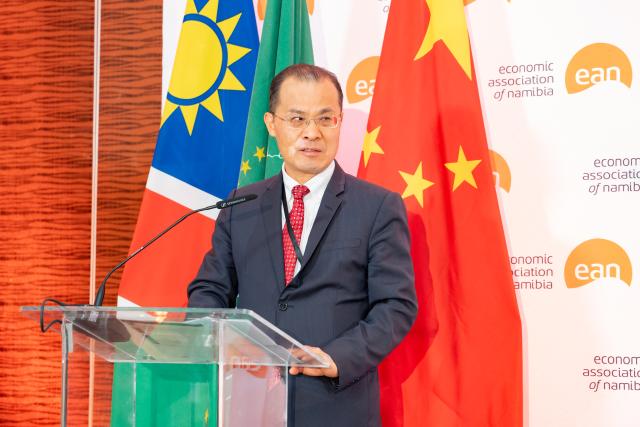
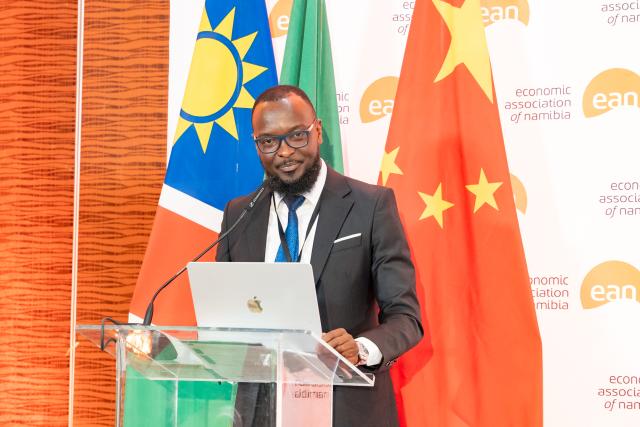
SWAKOPMUND, 10 September 2026 - (l-f)Chief Executive Officer of Namibia Hydrogen Fund Managers Mercia Geises, Interim CEO at Daures Fertiliser Martin Nambundunga and European Union Ambassador to Namibia Ana Beatrice Martins during the signing of the funding to advance the Green Fertiliser Project. (Photo by: Isabel Bento) NAMPA
OTJIWARONGO, 10 September 2026 - Government officials, including representatives from the Office of the Prime Minister (OPM), gathered in Otjiwarongo on Thursday to validate a newly compiled National Disaster Risk Management Policy document. (Photo: Mulisa Simiyasa) NAMPA
OTJIWARONGO, 10 September 2026 - The Executive Director in the Office of the Prime Minister, Shivute Indongo, speaks at the two-day National Disaster Risk Management Policy workshop underway at the Otjozondjupa Regional Council chambers in Otjiwarongo. (Photo: Mulisa Simiyasa) NAMPA
WINDHOEK, 10 September 2026 - The Bank of Namibia (BoN) has received two awards from the Alliance for Financial Inclusion (AFI). (Photo: Contributed)
WINDHOEK, 09 September 2026 - NHP representatives and journalists from various media houses at the NHP media engagement session held in Windhoek on Wednesday. (Photo: Contributed)
WINDHOEK, 09 September 2026 - Minister of Industries, Mines and Energy Modestus Amutse (second from left sitted)) pictured with delegates at the Second International Conference on Finance and Sustainable Business (ICFSB 2026) hosted at NUST's Harold Pupkewitz Graduate School of Business on Wednesday. (Photo: Contributed) NAMPA.
WINDHOEK, 09 September 2026 - Young Warriors goalkeeper Micheni Kavendjii during the Under-20 national team announcement ahead of the Confederation of Southern African Football Associations (COSAFA) Under-20 Championship in Mozambique. (Photo: Hesron Kapanga) NAMPA
WINDHOEK, 09 September 2026 - Young Warriors head coach Lucky Shipanga (right) and team goalkeeper Micheni Kavendjii during the Under-20 national team announcement ahead of the Cosafa Under-20 Championship in Mozambique. (Photo: Hesron Kapanga) NAMPA
(260911) -- YIWU, Sept. 11, 2026 (Xinhua) -- Indian entrepreneur Tanmay Gokani (R) is pictured with his son at a park in Yiwu City, east China's Zhejiang Province, Aug. 17, 2026. Coming to China in 2002, Tanmay Gokani worked at a Hong Kong firm's Shenzhen office before shifting his focus to Yiwu in east China's Zhejiang Province. To fund his startup venture between 2009 and 2011, Gokani scouted markets for suppliers by day and taught English after work. The Indian entrepreneur registered his consumer goods trading company in 2009. Rich in goods and warm-hearted people, Yiwu left a strong first impression on Gokani. Because of his business, Gokani has traveled to many countries and met people from all walks of life. Of all the places he has visited, Gokani said Yiwu is one of the friendliest places he has encountered for businesspeople from abroad. Now home to the world's largest small-commodity wholesale market, Yiwu hosts over 38,000 permanent foreign merchants and more than 10,000 foreign-funded enterprises. It has over 1.26 million business entities and supports employment for more than 32 million people. A key symbol of China's reform and opening-up, it has upgraded from a low-cost bulk trading hub into a digital marketplace where technology, branding and data match industrial scale in importance. Gokani stressed China's ultra-efficient supply chain, further empowered by AI, as its core advantage. He offered a striking example of an Indian client who confirmed a glass bowl order on a Saturday, with complete samples and quotation sheets ready the following Monday, and full shipments delivered by the month's end. Now, Gokani's firm ships 100 to 200 forty-foot containers yearly across thousands of products, with 90 percent of exports going to India, mostly ornaments and daily-use goods such as stationery, toys, hardware and other product categories, and the rest to the United States and Africa. For Gokani, life in Yiwu extends far beyond business. He often calls Yiwu his "adopted hometown." Gokani learned Chinese by watching Chinese movies and communicating with Chinese people. In 2015, he met his wife. After they got married, the family settled in Yiwu, where his son now attends school. Gokani also assists foreign residents' integration by facilitating international students' enrollment and joining multicultural festival activities, such as traditional sticky rice food zongzi-making for China's Dragon Boat Festival. (Xinhua/Jiang Han)
(260911) -- YIWU, Sept. 11, 2026 (Xinhua) -- Indian entrepreneur Tanmay Gokani (R) plays cricket with his son at a park in Yiwu City, east China's Zhejiang Province, Aug. 17, 2026. Coming to China in 2002, Tanmay Gokani worked at a Hong Kong firm's Shenzhen office before shifting his focus to Yiwu in east China's Zhejiang Province. To fund his startup venture between 2009 and 2011, Gokani scouted markets for suppliers by day and taught English after work. The Indian entrepreneur registered his consumer goods trading company in 2009. Rich in goods and warm-hearted people, Yiwu left a strong first impression on Gokani. Because of his business, Gokani has traveled to many countries and met people from all walks of life. Of all the places he has visited, Gokani said Yiwu is one of the friendliest places he has encountered for businesspeople from abroad. Now home to the world's largest small-commodity wholesale market, Yiwu hosts over 38,000 permanent foreign merchants and more than 10,000 foreign-funded enterprises. It has over 1.26 million business entities and supports employment for more than 32 million people. A key symbol of China's reform and opening-up, it has upgraded from a low-cost bulk trading hub into a digital marketplace where technology, branding and data match industrial scale in importance. Gokani stressed China's ultra-efficient supply chain, further empowered by AI, as its core advantage. He offered a striking example of an Indian client who confirmed a glass bowl order on a Saturday, with complete samples and quotation sheets ready the following Monday, and full shipments delivered by the month's end. Now, Gokani's firm ships 100 to 200 forty-foot containers yearly across thousands of products, with 90 percent of exports going to India, mostly ornaments and daily-use goods such as stationery, toys, hardware and other product categories, and the rest to the United States and Africa. For Gokani, life in Yiwu extends far beyond business. He often calls Yiwu his "adopted hometown." Gokani learned Chinese by watching Chinese movies and communicating with Chinese people. In 2015, he met his wife. After they got married, the family settled in Yiwu, where his son now attends school. Gokani also assists foreign residents' integration by facilitating international students' enrollment and joining multicultural festival activities, such as traditional sticky rice food zongzi-making for China's Dragon Boat Festival. (Xinhua/Jiang Han)
(260911) -- YIWU, Sept. 11, 2026 (Xinhua) -- Indian entrepreneur Tanmay Gokani (L) talks with an Indian merchant at the Yiwu International Trade Market in Yiwu City, east China's Zhejiang Province, Aug. 17, 2026. Coming to China in 2002, Tanmay Gokani worked at a Hong Kong firm's Shenzhen office before shifting his focus to Yiwu in east China's Zhejiang Province. To fund his startup venture between 2009 and 2011, Gokani scouted markets for suppliers by day and taught English after work. The Indian entrepreneur registered his consumer goods trading company in 2009. Rich in goods and warm-hearted people, Yiwu left a strong first impression on Gokani. Because of his business, Gokani has traveled to many countries and met people from all walks of life. Of all the places he has visited, Gokani said Yiwu is one of the friendliest places he has encountered for businesspeople from abroad. Now home to the world's largest small-commodity wholesale market, Yiwu hosts over 38,000 permanent foreign merchants and more than 10,000 foreign-funded enterprises. It has over 1.26 million business entities and supports employment for more than 32 million people. A key symbol of China's reform and opening-up, it has upgraded from a low-cost bulk trading hub into a digital marketplace where technology, branding and data match industrial scale in importance. Gokani stressed China's ultra-efficient supply chain, further empowered by AI, as its core advantage. He offered a striking example of an Indian client who confirmed a glass bowl order on a Saturday, with complete samples and quotation sheets ready the following Monday, and full shipments delivered by the month's end. Now, Gokani's firm ships 100 to 200 forty-foot containers yearly across thousands of products, with 90 percent of exports going to India, mostly ornaments and daily-use goods such as stationery, toys, hardware and other product categories, and the rest to the United States and Africa. For Gokani, life in Yiwu extends far beyond business. He often calls Yiwu his "adopted hometown." Gokani learned Chinese by watching Chinese movies and communicating with Chinese people. In 2015, he met his wife. After they got married, the family settled in Yiwu, where his son now attends school. Gokani also assists foreign residents' integration by facilitating international students' enrollment and joining multicultural festival activities, such as traditional sticky rice food zongzi-making for China's Dragon Boat Festival. (Xinhua/Jiang Han)
(260911) -- YIWU, Sept. 11, 2026 (Xinhua) -- Indian entrepreneur Tanmay Gokani (L) leads an Indian merchant to visit the Yiwu International Trade Market in Yiwu City, east China's Zhejiang Province, Aug. 17, 2026. Coming to China in 2002, Tanmay Gokani worked at a Hong Kong firm's Shenzhen office before shifting his focus to Yiwu in east China's Zhejiang Province. To fund his startup venture between 2009 and 2011, Gokani scouted markets for suppliers by day and taught English after work. The Indian entrepreneur registered his consumer goods trading company in 2009. Rich in goods and warm-hearted people, Yiwu left a strong first impression on Gokani. Because of his business, Gokani has traveled to many countries and met people from all walks of life. Of all the places he has visited, Gokani said Yiwu is one of the friendliest places he has encountered for businesspeople from abroad. Now home to the world's largest small-commodity wholesale market, Yiwu hosts over 38,000 permanent foreign merchants and more than 10,000 foreign-funded enterprises. It has over 1.26 million business entities and supports employment for more than 32 million people. A key symbol of China's reform and opening-up, it has upgraded from a low-cost bulk trading hub into a digital marketplace where technology, branding and data match industrial scale in importance. Gokani stressed China's ultra-efficient supply chain, further empowered by AI, as its core advantage. He offered a striking example of an Indian client who confirmed a glass bowl order on a Saturday, with complete samples and quotation sheets ready the following Monday, and full shipments delivered by the month's end. Now, Gokani's firm ships 100 to 200 forty-foot containers yearly across thousands of products, with 90 percent of exports going to India, mostly ornaments and daily-use goods such as stationery, toys, hardware and other product categories, and the rest to the United States and Africa. For Gokani, life in Yiwu extends far beyond business. He often calls Yiwu his "adopted hometown." Gokani learned Chinese by watching Chinese movies and communicating with Chinese people. In 2015, he met his wife. After they got married, the family settled in Yiwu, where his son now attends school. Gokani also assists foreign residents' integration by facilitating international students' enrollment and joining multicultural festival activities, such as traditional sticky rice food zongzi-making for China's Dragon Boat Festival. (Xinhua/Jiang Han)
(260911) -- YIWU, Sept. 11, 2026 (Xinhua) -- Indian entrepreneur Tanmay Gokani (R) plays cricket with his son at a park in Yiwu City, east China's Zhejiang Province, Aug. 17, 2026. Coming to China in 2002, Tanmay Gokani worked at a Hong Kong firm's Shenzhen office before shifting his focus to Yiwu in east China's Zhejiang Province. To fund his startup venture between 2009 and 2011, Gokani scouted markets for suppliers by day and taught English after work. The Indian entrepreneur registered his consumer goods trading company in 2009. Rich in goods and warm-hearted people, Yiwu left a strong first impression on Gokani. Because of his business, Gokani has traveled to many countries and met people from all walks of life. Of all the places he has visited, Gokani said Yiwu is one of the friendliest places he has encountered for businesspeople from abroad. Now home to the world's largest small-commodity wholesale market, Yiwu hosts over 38,000 permanent foreign merchants and more than 10,000 foreign-funded enterprises. It has over 1.26 million business entities and supports employment for more than 32 million people. A key symbol of China's reform and opening-up, it has upgraded from a low-cost bulk trading hub into a digital marketplace where technology, branding and data match industrial scale in importance. Gokani stressed China's ultra-efficient supply chain, further empowered by AI, as its core advantage. He offered a striking example of an Indian client who confirmed a glass bowl order on a Saturday, with complete samples and quotation sheets ready the following Monday, and full shipments delivered by the month's end. Now, Gokani's firm ships 100 to 200 forty-foot containers yearly across thousands of products, with 90 percent of exports going to India, mostly ornaments and daily-use goods such as stationery, toys, hardware and other product categories, and the rest to the United States and Africa. For Gokani, life in Yiwu extends far beyond business. He often calls Yiwu his "adopted hometown." Gokani learned Chinese by watching Chinese movies and communicating with Chinese people. In 2015, he met his wife. After they got married, the family settled in Yiwu, where his son now attends school. Gokani also assists foreign residents' integration by facilitating international students' enrollment and joining multicultural festival activities, such as traditional sticky rice food zongzi-making for China's Dragon Boat Festival. (Xinhua/Jiang Han)
(260911) -- YIWU, Sept. 11, 2026 (Xinhua) -- Indian entrepreneur Tanmay Gokani (1st R) walks at the Yiwu International Trade Market in Yiwu City, east China's Zhejiang Province, Aug. 17, 2026. Coming to China in 2002, Tanmay Gokani worked at a Hong Kong firm's Shenzhen office before shifting his focus to Yiwu in east China's Zhejiang Province. To fund his startup venture between 2009 and 2011, Gokani scouted markets for suppliers by day and taught English after work. The Indian entrepreneur registered his consumer goods trading company in 2009. Rich in goods and warm-hearted people, Yiwu left a strong first impression on Gokani. Because of his business, Gokani has traveled to many countries and met people from all walks of life. Of all the places he has visited, Gokani said Yiwu is one of the friendliest places he has encountered for businesspeople from abroad. Now home to the world's largest small-commodity wholesale market, Yiwu hosts over 38,000 permanent foreign merchants and more than 10,000 foreign-funded enterprises. It has over 1.26 million business entities and supports employment for more than 32 million people. A key symbol of China's reform and opening-up, it has upgraded from a low-cost bulk trading hub into a digital marketplace where technology, branding and data match industrial scale in importance. Gokani stressed China's ultra-efficient supply chain, further empowered by AI, as its core advantage. He offered a striking example of an Indian client who confirmed a glass bowl order on a Saturday, with complete samples and quotation sheets ready the following Monday, and full shipments delivered by the month's end. Now, Gokani's firm ships 100 to 200 forty-foot containers yearly across thousands of products, with 90 percent of exports going to India, mostly ornaments and daily-use goods such as stationery, toys, hardware and other product categories, and the rest to the United States and Africa. For Gokani, life in Yiwu extends far beyond business. He often calls Yiwu his "adopted hometown." Gokani learned Chinese by watching Chinese movies and communicating with Chinese people. In 2015, he met his wife. After they got married, the family settled in Yiwu, where his son now attends school. Gokani also assists foreign residents' integration by facilitating international students' enrollment and joining multicultural festival activities, such as traditional sticky rice food zongzi-making for China's Dragon Boat Festival. (Xinhua/Jiang Han)
(260911) -- YIWU, Sept. 11, 2026 (Xinhua) -- Indian entrepreneur Tanmay Gokani (1st L) watches his son playing with friends at a park in Yiwu City, east China's Zhejiang Province, Aug. 17, 2026. Coming to China in 2002, Tanmay Gokani worked at a Hong Kong firm's Shenzhen office before shifting his focus to Yiwu in east China's Zhejiang Province. To fund his startup venture between 2009 and 2011, Gokani scouted markets for suppliers by day and taught English after work. The Indian entrepreneur registered his consumer goods trading company in 2009. Rich in goods and warm-hearted people, Yiwu left a strong first impression on Gokani. Because of his business, Gokani has traveled to many countries and met people from all walks of life. Of all the places he has visited, Gokani said Yiwu is one of the friendliest places he has encountered for businesspeople from abroad. Now home to the world's largest small-commodity wholesale market, Yiwu hosts over 38,000 permanent foreign merchants and more than 10,000 foreign-funded enterprises. It has over 1.26 million business entities and supports employment for more than 32 million people. A key symbol of China's reform and opening-up, it has upgraded from a low-cost bulk trading hub into a digital marketplace where technology, branding and data match industrial scale in importance. Gokani stressed China's ultra-efficient supply chain, further empowered by AI, as its core advantage. He offered a striking example of an Indian client who confirmed a glass bowl order on a Saturday, with complete samples and quotation sheets ready the following Monday, and full shipments delivered by the month's end. Now, Gokani's firm ships 100 to 200 forty-foot containers yearly across thousands of products, with 90 percent of exports going to India, mostly ornaments and daily-use goods such as stationery, toys, hardware and other product categories, and the rest to the United States and Africa. For Gokani, life in Yiwu extends far beyond business. He often calls Yiwu his "adopted hometown." Gokani learned Chinese by watching Chinese movies and communicating with Chinese people. In 2015, he met his wife. After they got married, the family settled in Yiwu, where his son now attends school. Gokani also assists foreign residents' integration by facilitating international students' enrollment and joining multicultural festival activities, such as traditional sticky rice food zongzi-making for China's Dragon Boat Festival. (Xinhua/Jiang Han)
(260911) -- YIWU, Sept. 11, 2026 (Xinhua) -- Indian entrepreneur Tanmay Gokani (L) leads an Indian merchant to visit the Yiwu International Trade Market in Yiwu City, east China's Zhejiang Province, Aug. 17, 2026. Coming to China in 2002, Tanmay Gokani worked at a Hong Kong firm's Shenzhen office before shifting his focus to Yiwu in east China's Zhejiang Province. To fund his startup venture between 2009 and 2011, Gokani scouted markets for suppliers by day and taught English after work. The Indian entrepreneur registered his consumer goods trading company in 2009. Rich in goods and warm-hearted people, Yiwu left a strong first impression on Gokani. Because of his business, Gokani has traveled to many countries and met people from all walks of life. Of all the places he has visited, Gokani said Yiwu is one of the friendliest places he has encountered for businesspeople from abroad. Now home to the world's largest small-commodity wholesale market, Yiwu hosts over 38,000 permanent foreign merchants and more than 10,000 foreign-funded enterprises. It has over 1.26 million business entities and supports employment for more than 32 million people. A key symbol of China's reform and opening-up, it has upgraded from a low-cost bulk trading hub into a digital marketplace where technology, branding and data match industrial scale in importance. Gokani stressed China's ultra-efficient supply chain, further empowered by AI, as its core advantage. He offered a striking example of an Indian client who confirmed a glass bowl order on a Saturday, with complete samples and quotation sheets ready the following Monday, and full shipments delivered by the month's end. Now, Gokani's firm ships 100 to 200 forty-foot containers yearly across thousands of products, with 90 percent of exports going to India, mostly ornaments and daily-use goods such as stationery, toys, hardware and other product categories, and the rest to the United States and Africa. For Gokani, life in Yiwu extends far beyond business. He often calls Yiwu his "adopted hometown." Gokani learned Chinese by watching Chinese movies and communicating with Chinese people. In 2015, he met his wife. After they got married, the family settled in Yiwu, where his son now attends school. Gokani also assists foreign residents' integration by facilitating international students' enrollment and joining multicultural festival activities, such as traditional sticky rice food zongzi-making for China's Dragon Boat Festival. (Xinhua/Jiang Han)